Fermentor Designing and Process Conrtrols
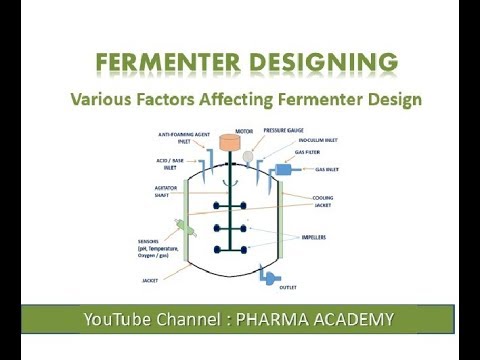
Fermenters are the closed vessels, with all required supportive accessories to provide aseptic and strict controlled environment to perform biochemical reactions, biotransformation and bioconversion of substrates into desirable products which are mediated by microbial cells.
Under appropriate culture conditions, microbial cells produce their metabolites, or produce commercially valuable products through bioconversions. Fermenters or bioreactors are fitted mainly with temperature, pH, aeration controlling systems, and various sensors to monitor the process. The term fermenter and bioreactors are used interchangeably, but there is some difference in these terms. Fermenters are used to culture only microbial cells, but in bioreactors, all type of cells, i.e. microbial, plant, mammalian and animal cells are used to culture and perform their biochemical reactions. Technically fermentation is the process, in which the conversion takes place from sugar to acids, gases or alcohol, but fermenters are use to mediate biochemical reactions by microbial cells.Under appropriate culture conditions, microbial cells produce metabolites or commercially valuable products. Fermenters (bioreactors) are fitted with temperature, pH, aeration control systems, and sensors to monitor processes.
Fermenter vs Bioreactor
Fermenters are used mainly for microbial cells, while bioreactors are used for microbial, plant, and animal cells. Technically fermentation refers to conversion of sugars into acids, gases, or alcohol.
Overview of Process
Fermentation is a complex set of reactions, in which a specifically selected population of microorganism convert the material and energy into product, within a controlled process environment.
The fermentation process takes place in fermenters or in bioreactors, the whole process has many steps which are described below by which converts the material into product.

Inoculum Development
Inoculum is the microbial seed culture, that use to perform the desired bioconversion reaction for the formation of product.
- Should be healthy and pure
- The inoculum should be in suitable morphologic form (vegetative form)
- The inoculum must be free from any contamination
- The inoculum must have appropriate metabolic capacity to form product.

After inoculation, the fermentation process begins and product formation occurs.
Downstream Processing
After inoculation of microbial strain / any other biomolecule in to the fermenter, the bioconversion process starts and the desired product is produced by the cells and released into the fermenter media / broth. After that the downstream process is used to get the formed product. Downstream processing in a fermenter refers to the stages after fermentation where the desired product is isolated, purified, and prepared for use. This includes separating the target product from the fermentation broth, concentrating it, and purifying it to remove impurities and contaminants. The basic process used for downstream process is showed below trough a flow diagram.It involves isolation, purification, and preparation of the final product after fermentation.

Designing, Process Controlls and Selection of Construction Material
The Fermenter has various parts and controls, which are designed as per the process requirements. The general or the basic components of any typical fermenter are shown in the picture below.
Constructional Materials
The constructional materials of a fermenter are chosen based on their ability to withstand biological, chemical, mechanical, and thermal stresses during fermentation processes. Below are the key properties required for constructional materials used in fermenter design:Corrosion-resistant:
- The material must resist corrosion from acidic or alkaline fermentation media.
- Should not react with medium components, microbial products, or cleaning agents
Non-toxic:
- Should not leach harmful substances into the fermentation broth.
- Must be inert to prevent interference with microbial growth or product formation.
Strength and Durability:
- Must withstand mechanical stress, such as pressure from gases and agitation.
Heat Resistance
- Should tolerate sterilization temperatures (typically 121°C during autoclaving or steam sterilization).
- Thermal expansion must be minimal and predictable.
Smooth and Non-porous Surface:
- Minimizes microbial contamination and biofilm formation.
- A smooth surface is easier to clean and sterilize.
Ease of Fabrication and Maintenance
- The material should allow easy welding, shaping, and assembly
- Should also support installation of ports, baffles, sensors, etc
Cost-effective and Easy available:
- The material should be economically feasible for both small- and large-scale fermenters.
- Readily available in the required grades and forms
Process Controls
Fermenter design incorporates various process controls to maintain optimal conditions for microbial growth and product formation.Temperature Control
The purpose of this is to maintain an optimal temperature for microbial activity because each microbial strain or biomolecule has its own optimum temperature for optimum cellular activities.
During the fermentation process heat can be produced mainly in two ways, firstly microbial biochemical reactions and secondly mechanical agitation. This can be control by Cooling jackets or coils with circulating water and heaters for warming. Thermostats and temperature sensors (thermocouples or RTDs) are used to control this.pH Control
Microbes require specific pH ranges for growth and metabolism thus it also has to be maintain at its suitable value. It is very important to monitor the pH values of media because sometime due to product formation pH gets change during process.
pH probes measure the acidity or alkalinity.Dissolved Oxygen (DO) Control
It has to maintained and control because most aerobic organisms need sufficient oxygen levels. aeration system ensures proper aeration and oxygen availability throughout the culture. DO probes measure oxygen levels in the medium. A sparger is a system used for introducing sterile air to a fermentation vessel. It helps in providing proper aeration to the vessel.
Agitation Control
Ensures uniform mixing of nutrient material and improves oxygen transfer It is achieved by Motor-driven impellers and controlled via variable speed motors or programmable controllers.
Foam Control
It is an important parameter to be controlled to prevent excessive foaming caused by microbial activity and proteins. Foam formation at the top of the media restricts air / gas access to the media which affects microbial cell activity.
It is monitored by using Foam sensors detect foam formation and controlled by automated or manual addition of antifoam agents.Pressure Control
It is important in sealed fermenters for gas exchange and safety.
Pressure valves, exhaust systems, and sensors. Bourdon tube pressure gauge, Diaphragm gauge, Piezoelectric transducer are some specific pressure monitor devices which are used with fermenters.Sterility Control
It is must to ensure sterile environment inside fermenter to prevent contamination and to produce pure products. Specially designed Valves are constructed to prevent contamination entry, including the use of flexible seals and diaphragms. Various physical, chemical and biological Sterility indicators are used specifically for this purpose.